Monday, September 30, 2013

POETIC TRIBUTE IN POETIC MEMORY OF THE ACADEMIC POETPROFESSOR KOFI AWOONOR FOR THE ATTENTION OF ANCESTOR POETS OF OURS IN THE POETIC KINGDOM OF AFRICAN WISDOM

By Mawutodzi Kodzo Abissath 


PROF. KOFI AWOONOR
MY TRANSITION
Oh, mourn not
Over my sleeping corpse,
For my humble soul
Is free for a higher course.
As the pain of living
Is faithfully relieved
By the joy of dying,
My blissful transition
Is but a sublime reincarnation
Through a wonderful initiation.
Rejoice, rejoice, rejoice!
For dead though i seem,
So alive still I am
Oh, mourn not
Over my sleeping corpse,
For my humbly soul
Is free for a higher course
MKA

THE SOUL
From Divinity
To humanity,
Like a ghost from the sea
In million manifold shapes
On its journey to manifest,
Wanders in the atmosphere
Only to convert into clouds
That darkens the bright horizon.
Then, into the sea it returns
In an incarnated form of a rain
To bring life to dying creatures
Crying on the deserted plain!
Yes, that downpour you see,
Is the fruit of an invisible vapour
That ascends into the heavens
When the sun’s rays,
Like the Holy Ghost
Descend on the ocean waves-
A divine process indeed!
It manifests itself in a wondrous
Fashion from eternity to eternity!
MKA

YOU WILL OBLIGE
An ancient woman I know,
How old she is – I don’t know,
Neither beautiful nor ugly she is;
But when she knocks at your door,
You will definitely oblige.
Nobody’s friend ever she is
But million’s foe she always is
When she knocks at your door,
You will oblige!
Whether wise or fool
When she knocks at your door,
You will oblige.
From animality to humanity,
When she knocks at your door,
You will oblige!
Beloved ancient woman,
Your action is inevitable,
But hardly acceptable
To the human kind,
Can you have some mercy
On humanity?
MKA
THE MAN POET
The unmade poet
Is a born lunatic.
Like the Atlantic,
A flood of ideas
Undulate in his mind
And burst on his tongue
Like the waves of the shore
At the explosion of his thoughts
In the city avenues even!
Ordinary eyes
Judge him abnormal,
But wise ears heed his counsel.
Little brains
Grope with his words,
But evolved souls
Grasp his thoughts;
A scientific madman indeed!
He uses the philosophers’ lab
For his lunatic researches
He rushes to the mystics’ asylum
For his dramatic experiments
And only few taste
His poetic philosophy!
Worthy brethren, brethren!
Cross the Man Poet you may,
“What a lunatic being,” you‘ll say,
Right or wrong you may be –
Why not seek ye the key
That reveals the poetic will?
MKA

SELECTED POEMS

 DEDICATED TO
PROFESSOR KOFI AWOONOR,
A FEARLESS INTELLECTUAL WARRIOR
WHO OBTAINED HIS HIGHEST INITIATION
IN THE HANDS OF SOME WAYWARD SOULS
OF PEACEFUL ISLAM IN GLOBAL TERRORISM
ON HIS MISSION OF LITERARY ILLUMINATION  
ON 21 SEPT., 2013 IN NAIROBI, KENYA -
POSTERITY WILL BE HIS JUDGE!

Contact: abissath@gmail.com


Thursday, September 5, 2013

Video Documentary Review
Reviewer:                       Mawutodzi   Abissath
Title:                                 Galamsey – The Real Price We Pay
Duration:                       30 Minutes
 Producer:                      Emmanuel Yuori
Some Foreign Galamsey Operators Destroying
Rivers in Ghana 
Do you remember the reaction of Apostle Thomas when he was told by his colleagues that the Master Jesus   appeared to them in a room without opening the door after resurrection? Most people who do not live in Ghana will behave like Thomas when they watch this video documentary about environmental criminality of   GALAMSEY.
Warning
GALAMSEY – The Price We Pay opens with a warning in accordance with cinematographic classification regulations thus:  “This documentary contains scenes that viewers may find DISTURBING. Viewer discretion is advised.”  This is professionalism in film production.
Garden of Eden
The documentary is structured in three main chapters chronologically:
Chapter one creatively and curiously takes the viewer through memory lanes of creation about five million years before Jesus was born. The screen play writer succeeded in projecting Ghana as the biblical Garden of Eden. But it was the narrator in the documentary who uses his deep-throat voice to transport the viewer into the Paradise itself.
 It was nostalgic to see and feel the originality of the   virgin rain forests of magnificent green vegetation.  And as demonstrated in the documentary, Ghana used to possess forests like the Garden of Eden where Adam and Even were located by the Creator. Aerial   view of the thick forest canopies was delightful to behold!
In those thick forests of natural beauty, timber trees of unimaginable proportion were in abundance.  Magnificent tributaries of rivers and stream crisscross one another culminating into one huge water body like the Volta River. Others like the Pra, Ankobra, Birim and Offinso rivers open their arms to other smaller rivers and carry them in unison into the mighty Atlantic Ocean. In fact, one can see all sorts of aquatic mammals like hippopotamus, charming and golden fishes some of which find their way into the cooking pots of our great –grand mothers. How beautiful is nature!
Among other dwellers of the fresh rivers was this   crocodile that could acrobatically catch a chicken thrown to it to the envy of a Black Stars goalkeeper like Robert Mensa of yesteryears. The documentary also shows how these rain forests play host to other wildlife species like the innocent antelopes and ever mischievous monkeys that snatch bananas and stuff them in their greedy jawbones.
Again, other agricultural biodiversity benefits of the forests which the documentary portrays are the cultivation of cash crops such as cocoa and oil palm plantations. One can see large tracks of these plantations with green and golden cocoa pods as well as millions of ripe orange fruits which are succulent to the eye in close shorts. In terms of food crops, the documentary projects particular bunch of plantain fingers that are as huge as baby tights. What a Ghana of heaven on earth!
 Galamsey Genocide
 Chapter two of the documentary focuses on the core issue at stake and   shows a sorry state of Ghana environmentally.  It is like the biblical hell of eternal fires. The scenes here are in shocking disparity of what the viewer saw in the first chapter.  
Again, the script writer employs rare artistic mastery in creative writing to evoke the emotions of the viewer where tears may be the result from the faint-hearted. And if this reviewer were granted the privilege to modify the title of the documentary, it would be something to this effect:  “Galamsey Genocide – The Environmental Criminality in Ghana.”
Reader, the documentary was able to prove beyond reasonable doubt that galamsey operators in Ghana have committed an environmental genocide not only against humanity but against nature and the Creator Himself for which they ought to face the International Criminal Court of Justice in The Hague, the Netherlands.
The biodiversity elements depicted in the first chapter ranging from the virgin forests with their dwellers from the tiniest ant to the largest mammal all vanished into tin air. The beautiful flowing fresh rivers water bodies created by God and preserved for millions of years for the benefit of present and future generations of Ghanaians   are completely extermited.
 This is the result of the diabolical handiwork of a few “greedy bastards” and selfish environmental criminals referred to as galamsey operators in Ghana. As was explained in the documentary by the Hon. Minister for Lands and Natural Resources Alhaji Inusah Fuseini, “Galamsey” is a corrupt English term for “gather them and sell.”  So because a few local selfish nation-wreckers and their evil-minded foreign cohorts want to gather gold dusts and sell humanity and biodiversity must be wiped out of the face of the earth?
Loss of Precious Souls
The documentary goes further to prove that apart from the devastating environment detrimental to sustainable development, precious human lives are being lost on regular basis through the devilish activities of these galamsey murderers in Ghana. One typical example depicted in the video was 16 precious souls that were lost in April 2013 at Offinso in the Ashanti Region.
It was known that people have been dying in galamsey pits in various parts of the country on daily basis. But that particular incident was a national tragedy.  The documentary captures very horrifying and most despicable scenes when the 16 lifeless bodies were laid in state ready for mass burials. And if you see how bereaved families including chiefs, queen-mothers , poor old women and men, orphan children who were deprived of their  loved ones and breadwinners were grieving in agony; the uncontrollable  sorrowful  wailing and weeping  were so  heart-wrecking that even if you’ve eaten a tortoise’s head , as the Ewes say, you would shed crocodile tears!
The documentary shows a footage of the funeral rite for that particular tragedy where Government officials including the Minister for Lands and Natural Resources was among the chief mourners. It was pathetic to say the least.
Galamsey operations might have be going on in this country for generations but the documentary demonstrates that when some foreigners introduced the use of modern excavation equipment that go right in the middle of rivers and dig deep down the belly of these rivers and water bodies completely poisoned and polluted thereby depriving communities the very sources of their drinking water and food production, Government could no longer afford to stand and stare any longer.
  That was the last straw that broke the back of the Carmel.  President John Dramani Mahama had to stand up and be countered. And his fearless decision to set up the Inter-ministerial Taskforce against illegal mining came into being. The success story of that committee is there in the documentary for the viewer to see.

The concluding chapter of the documentary deals with the solution and the way forward to the Galamsey problem in Ghana.

The purpose of this review is to render my only God-given national service by alerting my fellow compatriots about the existence of such a documentary in our midst. It is hoped that those who will watch GALAMSEY – THE PRICE WE PAY will give some credit to St. Thomas but not wait for Jesus to come and show him his wounds before believing. Galamsey is real in Ghana.

The author is Deputy Director and works with Information Services Dept. of the Ministry of Information and Media Relations in Accra, Ghana
Contact: abissath@gmail.com.

Thursday, August 1, 2013

TECHAIDE TAKES KNOWLEDGE TO RURAL GHANA VIA TECHNOLOGY
By Mawutodzi Abissath

MODERN  LIBRARIES AS A CENTRE FOR KNOWLEDGE
ACQUISITION RATHER THAN  A ROOM WHERE BOOKS
ARE STORED
Have you ever heard this sarcastic popular saying that, “If you want to hide something from a black man, put it in a book?” 

 Well, there may be some half-truths in this observation. However, in the opinion of this author, that scornful statement can be characterized as a fallacy of “hasty- generalization” in terms of logic.

Because, even though one may be able to hide something from a black man by putting it  in a book some of the time, it is not true that something put in a book can always  be hidden from all black people all of the time.

Mr. Kafui Prebbie, a young Ghanaian “techy savvy,” like many African bookworms, vows that no one on this planet of knowledge boom can hide anything from him by putting that thing in a book. And it is my considered view that there are many black men and women who can simply be described as “bibliophile” because they can hardly take away their noses from books.
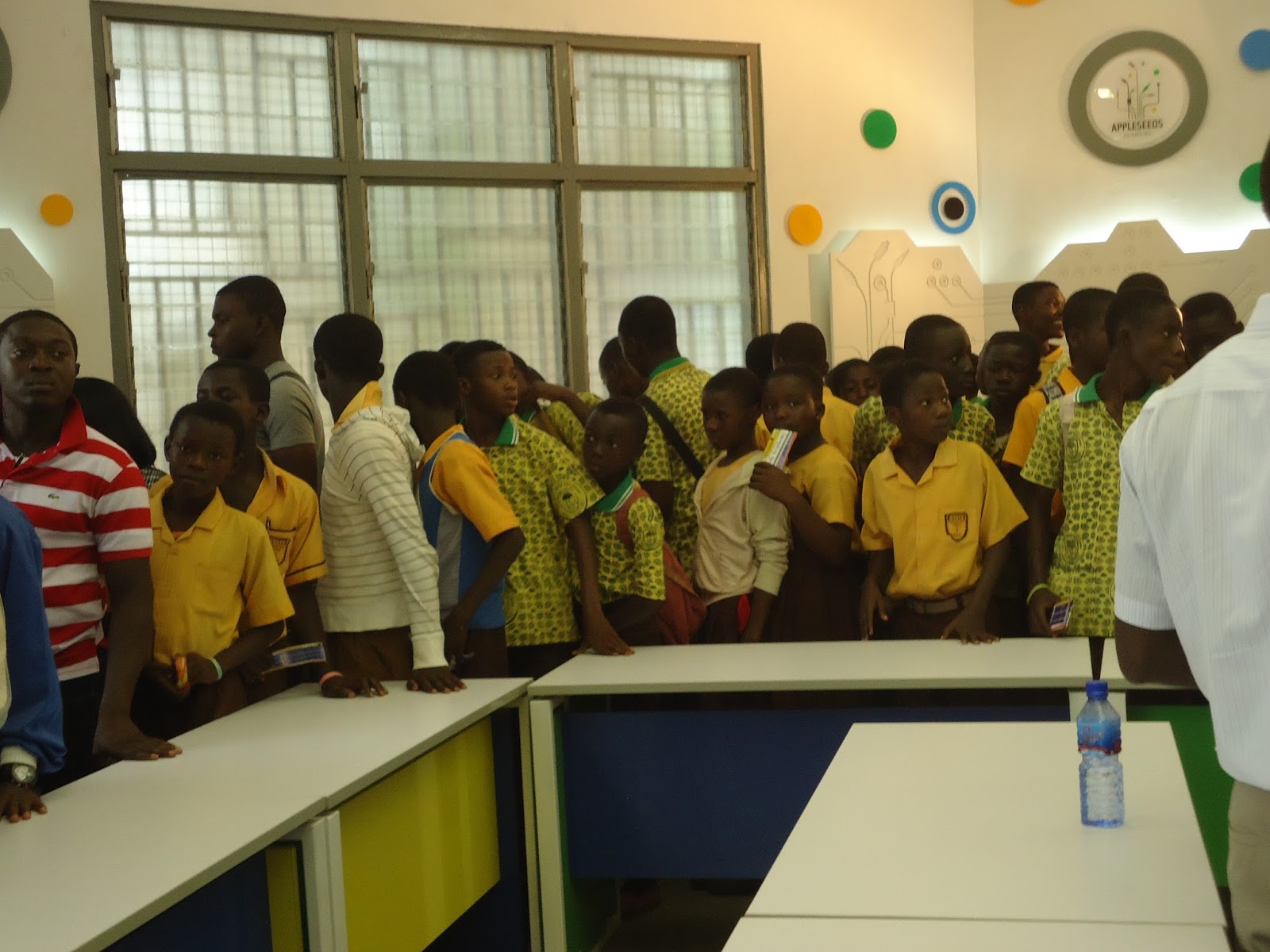
On Tuesday, July 9, 2013, within the premises of the State Boys School, Kumasi the noble consort of Asantehene, Lady Julia Osei Tutu Community Knowledge Center (CKC) was inaugurated by the madam herself under the auspices of The Otumfuo Osei Tutu II Charity Foundation. The event was very brief but colourful and witnessed by a multitude including this writer.
Mr. Kafui Prebbie Chief Executive Officer of TechAide, an Accra-based up-and-coming ICT firm, was among several other development partners who contributed in diverse ways for the realization of the Community Knowledge Centre project.  The Kumasi CKC is the first of two pilots projects earmarked for the Ashanti Region. The second one is expected be launched at Kenyasi for the benefit of rural communities. Vital Capital Fund is supporting the project financially.
 As a matter of fact, TechAide among other things,  provided IT technical services in terms of designing, installation, supplying and provision of unique Inveneo Certified low voltage computers, ICT hardware and software as well as technical training of the CKC Manager at over 100,00dollars value.
To throw more light on the involvement of TechAide in taking knowledge to rural and deprived people in Ghana through the establishment of community libraries, Mr. Prebbie granted an interview to this writer after the inauguration of the CKC in the Ashanti capital.
 According to Mr. Prebbie, between December 2010 and July 2011, a research study into the perception of public libraries was conducted in six African countries including Ghana. The other countries were Ethiopia. Kenya, Tanzania Uganda and Zimbabwe.
The study was commissioned by a European-based international not-for-profit organization known as EIFL’s Public Library Innovation Programme (PLIP). The actual research was conducted by TNS RMS East Africa. The focus of the study was to explore perceptions of public libraries in Africa among different stakeholders including people who use libraries and those who do not; government decision-makers, librarians themselves and library officials.
“The basic objective of the research was to better understand the status and role of libraries in Africa the vision, aspirations and expectations of library stakeholders,” disclosed Mr. Prebbie in our tête ă tête.  TechAide boss explained that the finding of the study was used to inform an outreach and advocacy efforts to build and strengthen policies and long-terms support for public libraries.
“In all the six African countries, an overwhelming majority of stakeholders - library users and non-users, librarians, library officials, government decision makers – perceive public libraries to be for books and study rather than spaces for technical innovation and provision of community development services,” the study revealed.
According to Mr. Prebbie, “only five percent of users and non-users associate libraries with information communication technology (ICT).”  The study also established a fact that funding for libraries is very low in local communities due to poverty. “Yet, all stakeholder groups believe that library services can improve lives and livehoods and contribute to community development goals,” the study concluded.
TechAIDE Chief Executive Officer disclosed that it was the findings of this research that most Africans, especially Ghanaians perceived libraries only as a place where books were stored rather than associate them with ICT. “This is what motivated me to embark of advocacy not only to create awareness about the benefit of library services for economic prosperity but to take knowledge to the door steps of rural poor through technology,” he stressed.
TechAide  is a technology social enterprise that is development-oriented and is poised to take knowledge to rural Ghana, by first conducting need assessments of the rural communities before providing professional services in various fields such as IT consulting and  training; project design and development; as well as technology project management, supply, installation and support services.
Other technology partners of TechAIDE who supported and witnessed the launching of the first ever Community Knowledge Centre in diverse ways in Kumasi were the Information Services Department (ISD) of the Ministry of Information and Media Relations, National Information Technology Agency and Ghana Investment Fund for Electronic Communications (GIFEC) all of the Ministry of Communications and the Ghana Library Authority; Vital Capital Fund, Appleseeds Academy, Google and Vodafone.


TechAID  Technology Partners cheerfully waiting
 for  their flight at theDomestic  Departure Hall
 in Accra Airport   en route to Kumasi


Mr. Kafui Prebbie, CEO, TechAID briefing Partners
 on arrival at the Community Knowledg Centre in Kuamsi 


Lady Julia Osei Tutu (sited middle) Wife of Otumfuo  Osei Tutu II

sharing  ideas  with some Development
 Partners after commissioning the CKC

School children and members of the public trooping
 to see what  the CKC has in stock for them


Unique Inveneo Certified Low Voltage 
Computers donated by TechAID to CKC


Mr. Prebbie hands over the special computers to
 the Ashanti Regional Director Ghana Library Board


Members of the public going round to view facilities at the CKC


Mr. Kafui Prebbie (left) explaining a point to 
a Journalist Mr. Kamel Nasan of GNA (second right)


TechAIDE CEO (back to camera) dramatising  things  
with passion to Technology Partners from Accra


Group photograph of  Technology Partners from Accra
 and some staff of TechAID who witnessed the event in Kumasi


Lady Julia Osei Tutu (middle)   with her royal entourage 
posed for the cameras at the end of the grand ceremony

  • Story and Photographs by Mawutodzi Kodzo Abissath, Deputy Director/Head of IT at the Information Services Department (ISD) of the Ministry of Information and Media Relations
Contact: abissath@gmail.com


Saturday, June 29, 2013


AFRICA ELECTIONS - GLOBAL EYES ARE WATCHING GHANA
BY MAWUTODZI ABISSATH

Presidential Canditates who constesd
the 2012  Elections in Ghana 
A very popular Ghanaian proverb affirms: “A child who knows how to wash his hands eats with kings.”
On 6th March 1957, when Ghana asserted itself as the first country in black Africa to wrench its independence from the colonial Britain, the country became the torchbearer of the black race and a global centre of political attention in Africa.
Since 1992 Ghana has held five successful presidential and parliamentary elections in the midst of democratic turbulent in continental elections. This feat motivated the international community to describe Ghana as the “beacon of democracy in Africa.
In fact, the European Union has politely declined an invitation to come down and observe 2012 elections in Ghana. In their estimation, Ghana has proved beyond doubt that the country has democratically matured and can manage its own electoral affairs without external supervision. This is the highest honor any African country can dream to attain in geo-politics.
Yet, the Former UN Secretary General Dr Kofi Annan has cautiously   noted that, “the best is yet to come.”   Dr Kofi Annan was recently reported in the Ghanaian media as saying, “When elections are conducted in integrity, without being disfigured by election motivated violence that is democracy.”
“Flawed elections can create unrest, setting back development by decades,” the wise veteran international diplomat opined.  Repercussions of election violence in some African countries such as Kenya, Serra- Leon and Cote d’Ivoire are still serving as scars on the conscience of Africa.
In seven days from the date of writing this piece, precisely on Friday, 7th December 2012, over 13million biometric registered voters Ghanaian will go to the polls to elect a president out of eight presidential candidates and 275 parliamentarians.
The writer has observed that the fear of the unknown is causing national psychological anxiety amongst Ghanaian electorates. The anxiety is even more intense amongst the presidential candidates themselves and their partisan supporters than the general electorates. Why? Because of the acrimonial campaign strategies some of the political parties have adopted as the voting date approaches. What to do?
Another Ghanaian proverb admonishes: “An elderly person at home does not sit down   to watch children engage in verbal argument that may lead to physical exchange of blows resulting in someone losing an eye or a tooth.” It was the traditional wisdom in this proverb that goaded Ghanaian elders to set a historical political record in Africa in 2012.  Do you want to know what happened?
On Tuesday, 27th November 2012, in cultural capital city of Kumasi in the Ashanti Region of Ghana, within the premises of the Kwame Nkrumah University of Science and Technology (KUNST) the National Peace Council did something that was unprecedented in the political history of Ghana if not in Africa.
   On that memorable day, the National Peace Council under the auspices of the modern Asante King, Otumfo Osei Tutu II, and with the technical and administrative support of an Accra –based Institute for
Democratic Governance, summoned all the presidential candidates to a rare meeting to pledge the people of Ghana that they would uphold peace, before, during and after the elections. Like prospective jobseekers   shortlisted for interview all eight presidential candidates humbly responded to the call.
President John Dramani Mahama, the National Democratic Congress (NDC), Dr Henry Lartey, the Great Consolidated Popular Party (GCPP), Nana Addo Dankwa Akufo-Addo, New Patriotic Party (NPP), Dr Paa Kwesi Nduom, Progressive People’s Party (PPP), Mr. Akwasi Addai, United Front Party (UFP), Mr. Hassan Ayariga, People’s National Convention (PNC), Dr Abu Sakara Foster, Convention People’s Party (CPP), who was represented by his running mate, Madam   Akosua Frimpomaa Sarpong Kumankuma and Mr. Joseph Osei Yeboah, Independent candidate,  all publicly signed a declaration to ensure peace during the December 7 polls.
The historic event was held under a broad them:  “Promoting peaceful elections and justice: Taking a stand against electoral violence, impunity and injustice.” The document to which the presidential candidates appended their signatures was dubbed as the “Kumasi Declaration” and was administered by no less a personality than the Chief Justice of the Republic of Ghana, Her Lordship Mrs. Justice Georgina Theodora Wood.  It was less like swearing an oath of office. And will hold them accountable to it.
The forum was made even more glamorous and glorious by the presence of the only two living Former Heads of state of the county since independence. They were President Jerry John Rawlings and President  John Agyekum Kufuor.  These statesmen did not only grace the occasion with their huge and giant physical persona but did share a few words of wisdom with those who were racing to sit on the hot throne they once occupied.
President Rawlings for instance, admonished that there was the need for fairness in the electoral process to prevent any unwanted situation. “Ghana has been blessed with peaceful transitions in the Fourth Republic and nothing must be made to dent this image,” he warned.
President Kufuor cautioned the presidential candidates not see the signing of the peace pact as something done for themselves but for the nation as a whole. “The security agencies and the Electoral Commission must do their work with diligence and honesty,” he advised.
Besides the two Former Commanders in- Chief  of the Ghana Armed Forces, current  Chief of Defence Staff, Lieutenant General Peter Augustine Blay, the Inspector General of Police, Paul Tawiah Quaye, and the President of the National House of Chiefs, Wulugu Naba Pugansua, Naa Professor John S. Nabila, were among the high profile personalities, who were at packed hall.
But one group of people who ought to be commended to the blue heaven is the religious gurus of our beloved country. From the Chairman of the Peace Council himself, the Most Rev Professor Emmanuel Asante, the Catholic Bishops Conference, the Christian Council, the Charistmatic Authorities, the Islamic Faith leaderships, the Traditional African Religious Authorities right down to ordinary church goes, Ghana must count itself blessed to be inhabited with souls that are amenable to peaceful co-existence regardless of race, creed or faith.
The purpose of this article is not to pretend to be holier than thou, but to politely refresh the memory of all compatriots that the entire globe is watching Ghana with one single eye. The world would want to see whether Ghana would be able once again conduct free, fair and peaceful elections in Africa.
As we go to the polls on that mystical day of 7th December, 2012, let us prove to ourselves and not anyone else that we are unique in the true sense of the word. Thant God is Ghanaian and Ghana is the chosen land of God to fulfill His own commandment of universal PEACE!

Writer is Deputy Director at the Information Services Department
Contact: abissath@gmail.com

Friday, June 28, 2013

Galamsey Operations   and Sustainable  Development in Ghana
By Mawutodzi Abissath

Environmental destruction of Galamsey operators
at work in Ghana
A popular Ghanaian proverb admonishes us thus: “ If you plant a tree before you die, your name will not die unless your tree also dies.”
Global lexicons of Ghanaian origin
Ghana seems to be one country in Africa that has ignited not only the taper  in the field of politics and democracy in terms of being the first black African nation to obtain independence in 1957.  Ghana has also contributed to the world “medico-scientific-lexicon”  where the term  “Kwashiorkor” , a Ga  word for  a childhood malnutrition disease that occurs when there is not enough protein in the diet.
Kwashiorkor
Kwashiorkor is now a vocabulary that has been adopted by the World Health Organisation (WHO) and has been in use since 1935 when a Jamaican pediatrician Dr. Cicely Williams was reported to have introduced it in medical community in her ‘Lancet article’, according to Wikipedia.
Sakawa
Anther  lexicon of Ghanaian origin in the field of technology  which  connotes negativity, though, but  is  gaining  global recognition is “Sakawa” which is widespread practice in Ghana that  combines modern  internet-based fraud practices with traditional religious rituals. The practice is mostly indulged in by the youth who are materialistically crazy and want to get rich quick without sweating in life.
Galamsey
Ghana is today confronted with an environmental catastrophe through “galamsey” which is a corrupt form for “gather and sell” simply refers to illegal small scale mining in our country. Galamsey has become another notorious lexicon of Ghanaian origin like Sakawa which is gaining global recognition as a vocabulary that can be written without putting it in quotes.
Many well-meaning Ghanaians are gravely concerned with the galamsey operations because they do not only affect the environment to the detriment of present generation but pose a threat to the very existence and survival of posterity as far as sustainable development and food security go.
Graphic Editorial
On Tuesday, June 11, 2013, the Daily Graphic wrote an editorial under the heading “Galamsey operations under fire,” (see page 7).  In that 20 paragraphs editorial comment, the paper focused on the work of the Inter-ministerial Task Force on illegal mining and their impact so far.
 The opening paragraph reads: “The move by the government to stop illegal mining in the country is yielding dividends.” And the 20th and last paragraph concludes:
“The DAILY GRAPHIC salutes the task force for a good work done so far, but they must keep their eyes on the ball to safeguard our natural resources for future generations.”
This author wants to pick it up from where the Daily Graphic’s editorial left off. What does the Daily Graphic mean by “… to safeguard our resources for future generations?” What are the natural resources and who are the future generations?  Well, on the face of the editorial page, the terms are common knowledge.
Biodiversity
But in the humble view of this writer, natural resources and future generations go beyond what we all know or understand them to be.  Most times when scientists or experts use their technical jargons in their technical research papers, they end up confusing us ordinary mortals on this planet of environmental confusion.
Thus, biodiversity, in this context simply refers to our fufu with any type of soup or sauce, be it palm nut, ground nut, light-soup or whatever we eat with that fufu.  It also refers to the banku or akple with okra soup or tilapia gravy as well as Ga or Fante kenkey with ‘abom’ or shitor that we enjoy with our bare fingers and not fork and knife.
In fact, if you eat fufu or banku or kenkey or akple with cutlery, you will not be able to lick   your fingers where the taste comes from. I don’t think we can substitute this traditional way of enjoying food electronically even if they are digitally cooked through microwaves.
Again biodiversity encompasses other resources like wood we use for charcoal; herbs we use for herbal medicine for “cooco”; spices, barks, fruits, nuts, medicines and so on. In fact, God is good that He made these resources plentiful and we use them freely that we take them for granted.
Other biodiversity which mankind, especially we Ghanaians  take for granted is referred to as “bio-physical” which embodies all living and non-living things including natural resources such as freshwater bodies. The current sorry state of Korle, Sakomonoo and Kpeshie lagoons all in Accra illustrates the point.
Again, look at what galamsey criminals have done and continue to do to our major rivers such as Pra, Densu, and Ankobra, even the almighty Volta River are all being poisoned, polluted and contaminated with reckless abandon. When we kill our rivers and water bodies, they don’t die alone but go to the grave with all other aquatic creatures from tiny fishes like “one- man-thousand” to huge mammals like hippopotamus. Who cares?
Environmental Laws of Ghana
Coincidentally,  on the very  day that the Daily Graphic wrote the editorial in question,(June 11,2013)  the Ghanaian Times , too, carried  a full page advertisers statement from the Environmental Protection Agency titled: “Compliance Notice” The write-up contains  the Environmental Assessment Regulation 1999 (L.I.1652) (see page 17). This author wonders whether anybody enforces these regulations.  
Agricultural Biodiversity
Research indicates that “at least 10% of the total land area of Ghana is under some form of protection for sustainability. Ghana’s economy is said to be largely dependent on agriculture. And agricultural biodiversity includes all the components of biological diversity for food and agriculture. That it consists of ecosystems known as “ agro-ecosystems” which “ is composed of the variety and variability of animals, plants and other organisms, at the genetic, species system, its structure and processes.”
Agricultural experts say that Ghanaian agro-ecosystems include food and cash crop plantations on all kinds of landscapes, animals husbandry and production and fishery. That food crops cultivated in Ghana include cassava, yam, cocoyam, sweet potato, onion, pepper, tomato, cabbage, garden egg, and other species, nuts, pods and pulses which give us our mouth-watering meals.
In Ghana, cash crops cultivated, according to the experts include cocoa, cola, coffee, shea, nutmeg, oil palm, coconut and many others. This research finding is contained in a brochure published by the erstwhile Ministry of Environment, Science and Technology in commemoration of 2010 International Year of Biodiversity, sponsored by the United Nations Development Programme UNDP.
What actually motivated this author to write this article was the conclusion in that brochure. “All of these agro-ecosystems have replaced natural vegetation, especially forest vegetation. Agricultural biodiversity must be properly conserved and used sustainably to continue to provide goods and services for sustainable development.”
My question is, Can galamsey operations guarantee sustainable development (what the French call “développement durable” in Ghana?  
The author  works with the Information Services Department in Accra
Contact: abissath@gmail.com


Wednesday, June 19, 2013


Tanzania in Ghana for Africa Public Service Day Celebrations
By Mawutodzi Abissath


About 20 African countries currently participating in the 2013 African Public Service Day in the Ghanaian capital Accra deserve felicitation for their sense of service to their people. But if there is one particular country that can be described as “champion” at the exhibition segment of the event’ it cannot be other than Tanzania.
At the foyer of the Accra International Conference Centre where participating countries mount their stands to exhibit not only their public service activities but the cultural and tourism heritage of their homelands, Tanzania alone occupies about one-third (1/3) of available space where over 100 exhibitors smartly dressed in their national colours are  attending to  visitors with broad smiles.
Hon. Celina O.Kombani (MP) Tanzanian Minister for Public/Civil Service who is leading his country’s delegation was among those who addressed the conference during the opening ceremony held on Monday, June 17 here in Accra.
Speaking on the theme “Citizen’s participation should be broadened beyond access to information and third party monitoring,’ Hon. Kombani who is also the Minister of State, President’s Office Public Service Management of the United Republic of Tanzania, said it’s essential for African  leaders to strengthen the accountability of natural resource revenues. “It is important to use the social media to improve the public ability to track implementation of election promises and building public trust in terms of governance and managing vital activities,” she underlined.

According to Hon. Kombani, the media must also be involved in self-help projects and public private partnership in medium and large scale projects; adding that “development goals cannot be achieved without participatory and citizen-centric public governance. She explained that “surveys on governance are conducted to echo the general consensus that accountability, transparency and integrity are fundamental to achieving good governance, development goals, quality and access to public services by the citizens,” she opined.
The Tanzanian Minister pointed out that Management Development Institutes (MDIs) in Africa are facing a number of challenges including inadequate funding; capacity to undertake applied research, consultancies, and policy studies relevant to address critical issues facing the public services. “Some of these challenges are arising from competition from other Institutions at national, continental and international levels that are better funded.”

Hon. Kombani reminded participants, especially public servants that there is a need to have a vision that will inspire, motivate and align people and systems towards a shared common good that will enable Africa to overcome some of these various challenges, in order “to build the future Africa we want, guided by the spirit of Pan Africanism  and African renaissance,” she stressed.

According to the Minister, a capable developmental state is one that is committed to ensuring a better life for all its citizens, promotes popular participation and the indigenous ownership of its entire development agenda whose public service is people-oriented, based on meritocracy and driven by service to its citizenry.
She advised African leaders to communicate to the public so as to enhance genuine trust between leaders and citizens; always acting as role models by doing honestly what is right in the eyes of citizens and empower them and pay attention to their development needs.
 Hon. Kombina paid tribute to Ghana’s first President Dr. Kwame Nkurumah, whom she described as  Great Son of Africa . The Accra event is the 4thEdition of the biennial APSD which is being held during the fiftieth anniversary of AU under the theme of “Pan Africanism and African Renaissance”
 The United Republic of Tanzania has already hosted the event twice since 2000 and over 42 government institutions are participating in the Ghana version which is being organised by the Tanzanian President Office, Public Service Management.
On the face of the attendance sheet, with over 100 delegates, Tanzania can be said to have landed in Ghana with the largest number of participants. This shows how serious they are.  And they are obviously   living by their first President and Founding father of the United Republic of
Tanzania, Mwalimu Julius Kambarage Nyerere, who once stated: “It can be done, play your part.”
Story by Mawutodzi Abissath with extra files and photographs from Florence Lawrence of United Republic of Tanzania
Contact: abissath@gmail.com.